Contents
The Illusion of Total Control Through Knowledge Bases
Modern companies are obsessed with documentation. Managers create endless pages in Notion, corporate Wikis, knowledge bases in Confluence, and write Standard Operating Procedures (SOPs) for every sneeze. It seems the business is securely protected. But then the day comes when a single Senior Developer or a key Project Manager resigns, and suddenly, entire processes collapse. Why? Because the most valuable information was never written down. It existed only in that person’s head.
Tacit Knowledge is the True Foundation of a Company
This phenomenon is called “Silent Knowledge” or “Tacit Knowledge.”
The concept was first introduced by philosopher Michael Polanyi, who articulated it as: “We can know more than we can tell” (Wikipedia). It’s intuition, context awareness, knowing exactly which stakeholder to approach when everything is on fire, and understanding why a certain piece of code or process is built the way it is. It’s the kind of information that cannot be squeezed into a standard manual.
Deep Dive: Why Documentation Doesn’t Prevent Disaster
1. Notion Bases Are Outdated the Day They Are Published
Documentation captures the ideal state of affairs, the so-called “Happy Path.” But real business is chaos, exceptions, and daily changes. The moment you finish writing a detailed instruction, the process has already evolved. People stop reading the Wiki because it quickly turns into a graveyard of irrelevant information.
2. Context Breakdown: Why “Handover” is a Fiction
When a key carrier of tacit knowledge decides to leave, the company initiates a standard handover process, usually lasting two weeks. But this is a false sense of security. It is impossible to transfer three years of accumulated context, past mistakes, and invisible relationships via a few Zoom calls and Google Docs (this highlights the “Bus factor” — the number of people who need to be hit by a bus before the project stalls:Wikipedia). The new person gets access to all systems but loses the context of decision-making. Paralysis or unintentional sabotage ensues.
Practical Advice: How to Share Context, Not Dry Text
You cannot document everything. But you can build a culture where “tacit knowledge” continuously flows between people on the level of daily practice.
Move Communication to the Public Domain
Ban the making of product or technical decisions in Direct Messages (DMs). All discussions should take place in open Slack channels or task comments. This creates a digital footprint of context—why a decision was made, not just what it was (About.gitlab).
Shadowing and Pair Work
The best way to transfer tacit knowledge is through collaborative execution. Practice pair programming or invite junior/middle staff to silently sit in (Shadowing) on complex client negotiations. Knowledge is transferred by observing the expert’s logic in action, not by reading their manuals.
A Culture of Post-mortems
Instead of just describing the “right” way to work, thoroughly document your failures. At Google, this is known as Blameless Post-Mortems (Sre.google). When a crisis hits, the team records what went wrong, how it was identified, and how it was fixed. This is where the highest concentration of real, “battle-tested” knowledge resides.
Conclusion
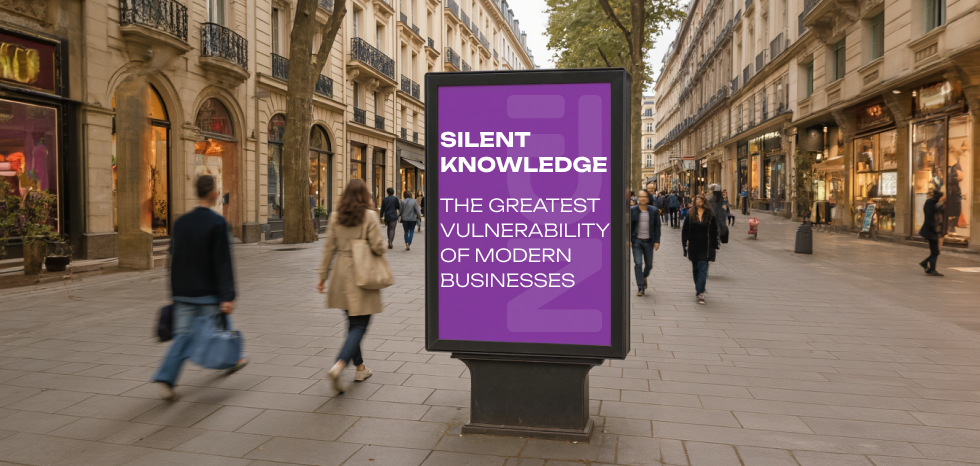
The greatest vulnerability of modern business is the belief that Notion or Google Drive can replace human context. A company’s true resilience is built not on the number of written procedures, but on the team’s ability to continuously exchange experience during the actual work process. Invest in communication and collaborative practice, not in building dead libraries.
 Telegram
 Instagram
 Subscribe via E-mail